The Sun
The Sun is a yellow dwarf star (G2V), about 4.6 billion years old, and the dominant gravitational force in the Solar System. It has a diameter of roughly 1.4 million kilometers and contains around 99.8% of the Solar System’s mass. Nuclear fusion in its core converts hydrogen into helium, producing energy that warms the planets. Above the core lie the radiative and convective zones, followed by the visible photosphere (~5,500 °C), the chromosphere, and the much hotter corona (~2 million °C).
Source: science.nasa.gov
APODs including "The Sun"
Sunshine, Earthshine at the Lunar Limb
30/05/1996
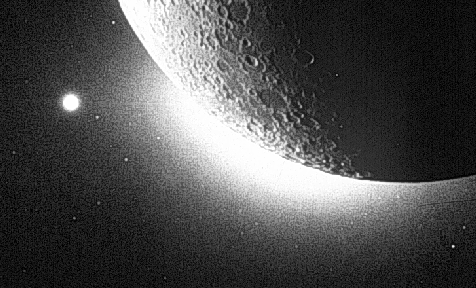
This dramatic image of the Moon's edge against a background of distant stars is from a perspective impossible for groundbased telescopes. It was taken by a star tracker camera onboard the Clementine spacecraft. The Solar Corona, the Sun's outer atmosphere, is visible shining brightly behind the lunar limb while the Moon's surface is illuminated by Earthshine, sunlight reflected from the Earth to the Moon. As pictured, the part of the Moon in shadow is the lunar farside, the side not visible from Earth. The highly successful unmanned Clementine probe explored the Moon from lunar orbit during March and April of 1994. Its star tracker cameras were normally used for celestial navigation, producing wide angle images showing relative positions of stars.