The Sun
The Sun is a yellow dwarf star (G2V), about 4.6 billion years old, and the dominant gravitational force in the Solar System. It has a diameter of roughly 1.4 million kilometers and contains around 99.8% of the Solar System’s mass. Nuclear fusion in its core converts hydrogen into helium, producing energy that warms the planets. Above the core lie the radiative and convective zones, followed by the visible photosphere (~5,500 °C), the chromosphere, and the much hotter corona (~2 million °C).
Source: science.nasa.gov
APODs including "The Sun"
The Voyagers' Message in a Bottle
29/06/1996
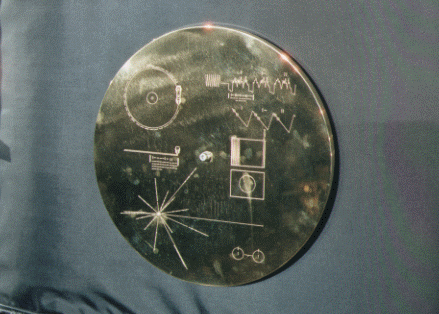
Launched in the summer of 1977, NASA's Voyager 1 and 2 spacecraft are now over 4.5 billion miles from the Sun. Still operational, the Voyagers are being tracked and commanded through the Deep Space Network. Having traveled beyond the outer planets, these remarkable spacecraft are only the third and fourth human built artifacts to escape our solar system, following in the footsteps of Pioneer 10 and 11. A 12-inch gold plated copper disk (pictured) containing recorded sounds and images representing human cultures and life on Earth, is affixed to each Voyager - a message in a bottle cast into the cosmic sea. The recorded material was selected by a committee chaired by Carl Sagan of Cornell University. The disks are intended to be played like a phonograph record at 16 and 2/3 revolutions per second. Cartridge and needle are supplied, along with some simple diagrams (visible above) which represent symbolically the spacecraft's origin and instructions for playing the disk. The exotic construction of the disks should provide them with a long lifetime as they coast through interstellar space. The two spacecraft will not make a close approach to another planetary system for at least 40,000 years.