The Sun
The Sun is a yellow dwarf star (G2V), about 4.6 billion years old, and the dominant gravitational force in the Solar System. It has a diameter of roughly 1.4 million kilometers and contains around 99.8% of the Solar System’s mass. Nuclear fusion in its core converts hydrogen into helium, producing energy that warms the planets. Above the core lie the radiative and convective zones, followed by the visible photosphere (~5,500 °C), the chromosphere, and the much hotter corona (~2 million °C).
Source: science.nasa.gov
APODs including "The Sun"
Greetings from the Pioneers
30/06/1996
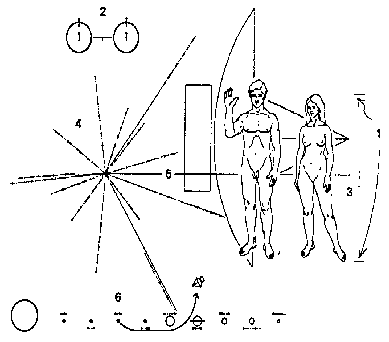
Launched in the early 1970s Pioneer 10 and 11 were appropriately named - becoming the first spacecraft to travel through the asteroid belt, first to fly by Jupiter and Saturn, and the first human artifacts to venture beyond the solar system. Now coasting through interstellar space, they carry with them greetings in the form of a gold anodized plaque with symbolic drawings as illustrated above. The male and female figures are drawn to the same scale as the Pioneer spacecraft shown behind them. Immediately to the left is a map of the position of the sun with respect to nearby pulsars and the center of the galaxy while below is a drawing of the solar system indicating the planet of origin. In the upper left is a schematic of two fundamental states of the hydrogen atom. These diagrams along with other details of the plaque were designed by Carl Sagan of Cornell University and are intended to be decipherable by spacefaring extraterrestrial civilizations.