The Sun
The Sun is a yellow dwarf star (G2V), about 4.6 billion years old, and the dominant gravitational force in the Solar System. It has a diameter of roughly 1.4 million kilometers and contains around 99.8% of the Solar System’s mass. Nuclear fusion in its core converts hydrogen into helium, producing energy that warms the planets. Above the core lie the radiative and convective zones, followed by the visible photosphere (~5,500 °C), the chromosphere, and the much hotter corona (~2 million °C).
Source: science.nasa.gov
APODs including "The Sun"
Superbubbles in the LMC
03/07/1996
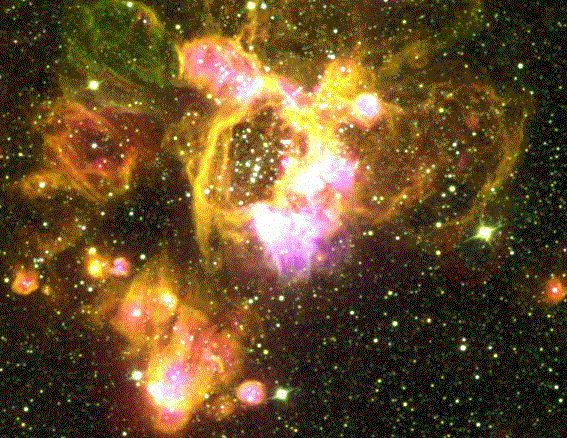
Why is there a hole in the center of this nebula? A leading explanation is that it is caused by the stellar winds from the stars that live there. Stars - including the Sun - expel electrons, protons, and other charged ions in a steady stream - the stellar wind. The wind ions push out the normal hydrogen and helium gas found glowing in the nebula. This star forming region is located in the Large Magellanic Cloud. This picture is a composite of three separate photographs, each sensitive to only one specific color of light - a color that distinguishes a specific chemical element. It is currently not known why stars emit a stellar wind.