The Sun
The Sun is a yellow dwarf star (G2V), about 4.6 billion years old, and the dominant gravitational force in the Solar System. It has a diameter of roughly 1.4 million kilometers and contains around 99.8% of the Solar System’s mass. Nuclear fusion in its core converts hydrogen into helium, producing energy that warms the planets. Above the core lie the radiative and convective zones, followed by the visible photosphere (~5,500 °C), the chromosphere, and the much hotter corona (~2 million °C).
Source: science.nasa.gov
APODs including "The Sun"
Ganymede: A Really Groovy Moon
11/07/1996
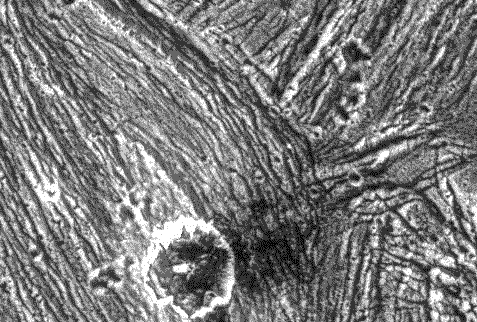
Ganymede's surface is a wrinkled mess. As large ice-sheets shift on the moon's surface, parts of the surface buckle causing high ridges, deep furrows, and parallel grooves. This photo, taken by the Galileo spacecraft currently orbiting Jupiter, was released yesterday. The large circular feature near the picture bottom is a large impact crater. The impact that caused this large crater also caused the strange dark ejecta seen to the crater's right. The Sun illuminates the scene from the lower left. The Galileo spacecraft has also just discovered that Ganymede has a region of orbiting charged particles called a magnetosphere - a first for any moon. How Ganymede is able to generate a magnetosphere is a mystery. APOD's Archive of Galileo at Ganymede