The Sun
The Sun is a yellow dwarf star (G2V), about 4.6 billion years old, and the dominant gravitational force in the Solar System. It has a diameter of roughly 1.4 million kilometers and contains around 99.8% of the Solar System’s mass. Nuclear fusion in its core converts hydrogen into helium, producing energy that warms the planets. Above the core lie the radiative and convective zones, followed by the visible photosphere (~5,500 °C), the chromosphere, and the much hotter corona (~2 million °C).
Source: science.nasa.gov
APODs including "The Sun"
A Violet Moon
31/07/1996
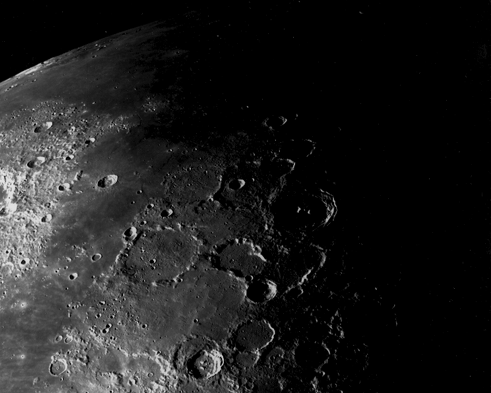
Checking out the Galileo spacecraft's cameras during its December 1992 flyby of Earth's Moon, controllers took this dramatically illuminated picture through a violet filter. The view looks down on the Moon's north polar region with the Sun shining from the left at a low angle and the direction toward the moon's North pole toward the lower right. Across the image upper left stretches the smooth volcanic plain of the Mare Imbrium. Pythagoras crater, 65 miles wide, is near the center of the image -- mostly in shadow, its central peak just catches the sunlight. Yesterday, the Moon made its closest approach to Earth and was full for the second time in July (as reckoned by UT dates). The closest point in the Moon's orbit is referred to as Lunar Perigee, a mere 221,797 miles at 8 hours UT. The second full moon in a month is known as a "Blue Moon".