The Sun
The Sun is a yellow dwarf star (G2V), about 4.6 billion years old, and the dominant gravitational force in the Solar System. It has a diameter of roughly 1.4 million kilometers and contains around 99.8% of the Solar System’s mass. Nuclear fusion in its core converts hydrogen into helium, producing energy that warms the planets. Above the core lie the radiative and convective zones, followed by the visible photosphere (~5,500 °C), the chromosphere, and the much hotter corona (~2 million °C).
Source: science.nasa.gov
APODs including "The Sun"
The Ecliptic Plane
21/09/1996
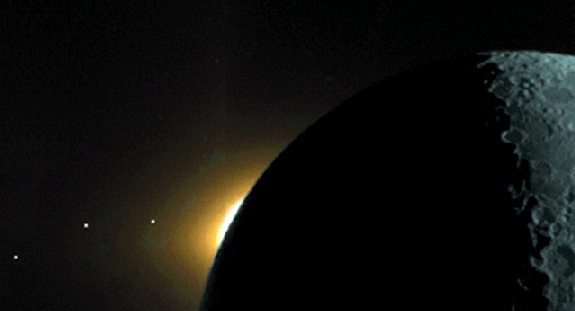
The Plane of the Ecliptic is illustrated in this Clementine star tracker camera image which reveals (from right to left) the Moon lit by Earthshine, the Sun's corona rising over the Moon's dark limb, and the planets Saturn, Mars, and Mercury. The ecliptic plane is defined as the imaginary plane containing the Earth's orbit around the Sun. In the course of a year, the Sun's apparent path through the sky lies in this plane. The planetary bodies of our solar system all tend to lie near this plane, since they were formed from the Sun's spinning, flattened, proto-planetary disk. The snapshot above nicely captures a momentary line-up looking out along this fundamental plane of our solar system. Information: Thursday, September 26 - A Total Lunar Eclipse