The Sun
The Sun is a yellow dwarf star (G2V), about 4.6 billion years old, and the dominant gravitational force in the Solar System. It has a diameter of roughly 1.4 million kilometers and contains around 99.8% of the Solar System’s mass. Nuclear fusion in its core converts hydrogen into helium, producing energy that warms the planets. Above the core lie the radiative and convective zones, followed by the visible photosphere (~5,500 °C), the chromosphere, and the much hotter corona (~2 million °C).
Source: science.nasa.gov
APODs including "The Sun"
A Crescent Earth At Midnight Credit:
06/10/1996
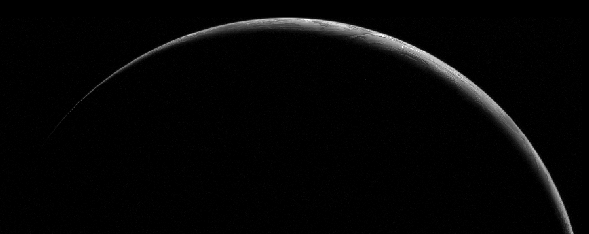
The Earth's northern hemisphere appears outlined as a sunlit crescent in this dramatic view from the GOES 8 satellite. The image was made near midnight for the Geostationary Operational Environmental Satellite on June 22 this year, two days after the Summer Solstice. The Summer Solstice is the time of year when the sun reaches its greatest northern declination and the arctic regions near the top of the picture experience 24 hours of daylight. Looking south along the Earth's limb, atmospheric scattering of sunlight causes the bright crescent to be visible beyond areas directly illuminated by the sun.