The Sun
The Sun is a yellow dwarf star (G2V), about 4.6 billion years old, and the dominant gravitational force in the Solar System. It has a diameter of roughly 1.4 million kilometers and contains around 99.8% of the Solar System’s mass. Nuclear fusion in its core converts hydrogen into helium, producing energy that warms the planets. Above the core lie the radiative and convective zones, followed by the visible photosphere (~5,500 °C), the chromosphere, and the much hotter corona (~2 million °C).
Source: science.nasa.gov
APODs including "The Sun"
Io's Shadow Credit:
07/10/1996
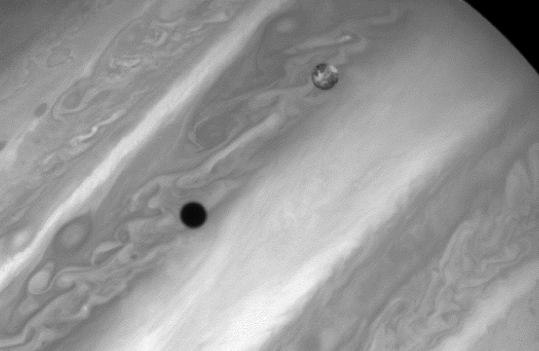
Caught in the act earlier this summer by the Hubble Space Telescope, the volcanic moon Io (above and right of center) and its shadow (black dot) are seen here against Jupiter's clouds. Io's shadow is 2,262 miles in diameter (about the size of Io) as it races across the swirling cloud tops at about 38,000 miles per hour. From our perspective in the inner Solar System, dramatic scenes like this one are possible when Jupiter, Io, and the Sun line up. What would this scene look like when viewed from Jupiter's cloud tops? As the shadow passed over Jupiter, for observers along the shadow's track, Io's disk would appear to eclipse the sun. The situation is familiar to those Earth Dwellers who have seen a Solar Eclipse - visible from along the track of the Moon's shadow passing across the surface of the Earth.