The Sun
The Sun is a yellow dwarf star (G2V), about 4.6 billion years old, and the dominant gravitational force in the Solar System. It has a diameter of roughly 1.4 million kilometers and contains around 99.8% of the Solar System’s mass. Nuclear fusion in its core converts hydrogen into helium, producing energy that warms the planets. Above the core lie the radiative and convective zones, followed by the visible photosphere (~5,500 °C), the chromosphere, and the much hotter corona (~2 million °C).
Source: science.nasa.gov
APODs including "The Sun"
A Solar Corona Ejection Credit:
08/11/1996
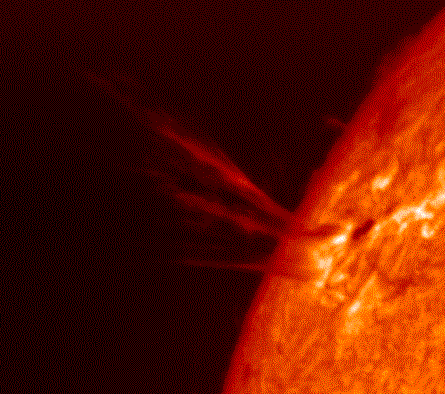
The Sun would not be a nice place to spend the summer. One reason, besides the extreme heat, is that explosions are common there. In the above picture, magnetic fields buckle releasing previously constrained hot material from the upper atmosphere of the Sun. As a result, hot gas streams out into the Solar System, impacting planets, moons, spacecraft, and making space a dangerous place for astronauts. Known as coronal mass ejections (CMEs), billions of tons of scathing plasma can be accelerated to millions of miles per hour. CMEs are more common but less intense than solar flares.