The Sun
The Sun is a yellow dwarf star (G2V), about 4.6 billion years old, and the dominant gravitational force in the Solar System. It has a diameter of roughly 1.4 million kilometers and contains around 99.8% of the Solar System’s mass. Nuclear fusion in its core converts hydrogen into helium, producing energy that warms the planets. Above the core lie the radiative and convective zones, followed by the visible photosphere (~5,500 °C), the chromosphere, and the much hotter corona (~2 million °C).
Source: science.nasa.gov
APODs including "The Sun"
Supernova Remnant and Neutron Star
14/11/1996
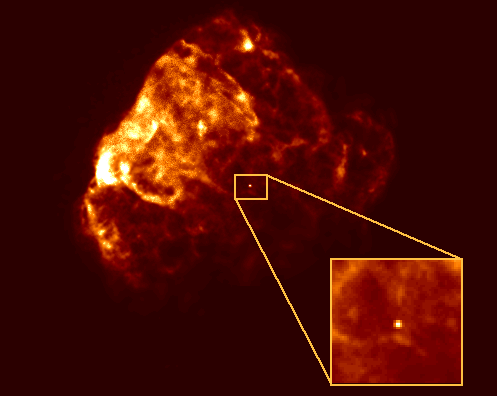
A massive star ends life as a supernova, blasting its outer layers back to interstellar space. The spectacular death explosion is initiated by the collapse of what has become an impossibly dense stellar core. However, this core is not necessarily destroyed. Instead, it may be transformed into an exotic object with the density of an atomic nucleus but more total mass than the sun - a neutron star. Directly viewing a neutron star is difficult because it is small (roughly 10 miles in diameter) and therefore dim, but newly formed in this violent crucible it is intensely hot, glowing in X-rays. Images from the ROSAT X-ray observatory above may offer a premier view of such a recently formed neutron stars' X-ray glow. Pictured is the supernova remnant Puppis A, one of the brightest sources in the X-ray sky, with shocked gas clouds still expanding and radiating X-rays. In the inset close-up view, a faint pinpoint source of X-rays is visible which is most likely the young neutron star, kicked out by the asymmetric explosion and moving away from the site of the original supernova at about 600 miles per second.