The Sun
The Sun is a yellow dwarf star (G2V), about 4.6 billion years old, and the dominant gravitational force in the Solar System. It has a diameter of roughly 1.4 million kilometers and contains around 99.8% of the Solar System’s mass. Nuclear fusion in its core converts hydrogen into helium, producing energy that warms the planets. Above the core lie the radiative and convective zones, followed by the visible photosphere (~5,500 °C), the chromosphere, and the much hotter corona (~2 million °C).
Source: science.nasa.gov
APODs including "The Sun"
Aurora Astern Credit:
30/11/1996
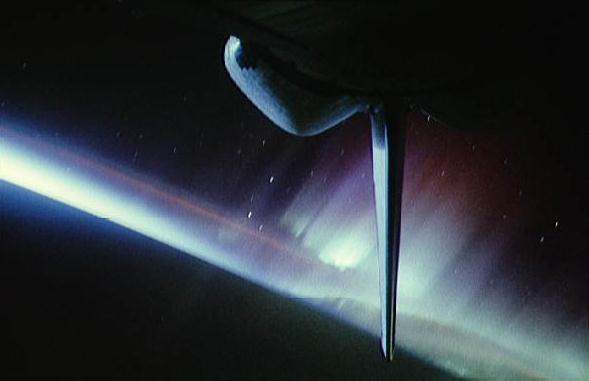
Sailing upside down, 115 nautical miles above Earth, the crew of the Space Shuttle Endeavour made this spectacular time exposure of the southern aurora (aurora australis) in October of 1994. The aurora, also known as the northern and southern lights, appear as luminous bands or streamers of light which can extend to altitudes of 200 miles. They are typically visible from the Earth's surface at high latitudes and are caused by high energy particles from the Sun. The delicate colors are caused by energetic electrons colliding with oxygen and nitrogen in the atmosphere. In this picture, the rear structure of the Space Shuttle is visible in the foreground with the vertical tail fin pointed toward Earth. Star trails are visible as small streaks above Earth's horizon.