The Sun
The Sun is a yellow dwarf star (G2V), about 4.6 billion years old, and the dominant gravitational force in the Solar System. It has a diameter of roughly 1.4 million kilometers and contains around 99.8% of the Solar System’s mass. Nuclear fusion in its core converts hydrogen into helium, producing energy that warms the planets. Above the core lie the radiative and convective zones, followed by the visible photosphere (~5,500 °C), the chromosphere, and the much hotter corona (~2 million °C).
Source: science.nasa.gov
APODs including "The Sun"
Comet Hale-Bopp Inbound Credit:
19/12/1996
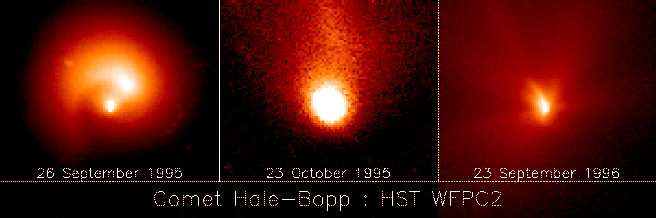
Headed toward the inner Solar System, the much anticipated Comet Hale-Bopp has promised to put on a big show next spring. The comet's apparent brightness is currently approaching 4th magnitude and its inbound journey has been closely followed by many observers. But because it is now so near the Sun's position in the sky it is a difficult target for large ground based optical telescopes as well as the orbiting Hubble Space Telescope (HST). This series of HST images hints at the comet's evolution during the last year, illustrating active and quiescent phases. Hidden from direct view by the dusty cometary coma, Hale-Bopp's nucleus is centered in each frame. A single telescopic image of the comet has recently caused substantial activity on the internet based on false claims of the existence of a mysterious companion. However, the mystery guest turned out to be an 8th magnitude star! Many predict that by next spring telescopes large or small will not be needed to appreciate the true spectacle of Hale-Bopp as it blossoms into a naked-eye astronomical wonder.