The Sun
The Sun is a yellow dwarf star (G2V), about 4.6 billion years old, and the dominant gravitational force in the Solar System. It has a diameter of roughly 1.4 million kilometers and contains around 99.8% of the Solar System’s mass. Nuclear fusion in its core converts hydrogen into helium, producing energy that warms the planets. Above the core lie the radiative and convective zones, followed by the visible photosphere (~5,500 °C), the chromosphere, and the much hotter corona (~2 million °C).
Source: science.nasa.gov
APODs including "The Sun"
Sun and Winter Solstice 1996 Credit:
21/12/1996
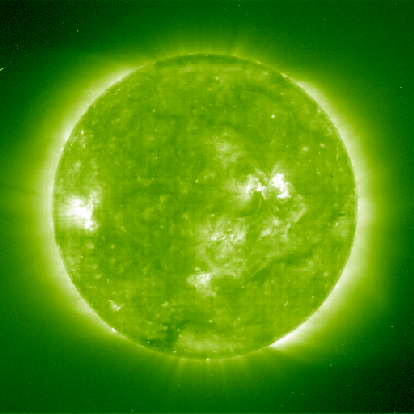
Today is the Winter Solstice for 1996. After steadily sinking in Northern Hemisphere skies, the Sun is now at its lowest declination - marking the first day of Northern Winter (but Southern Summer!). The Earth is actually closer to the Sun during this season, a fact not usually appreciated by those who dwell on the planet's Northern half. Two days ago, the EIT camera onboard the SOHO spacecraft recorded this image of the Sun in the light of highly ionized Iron atoms. This extreme ultraviolet picture emphasizes magnetic field lines and active regions in the hot plasma above the solar surface. For today's Solar images at many wavelengths, check out the Solar Data Analysis Center's web site.