The Sun
The Sun is a yellow dwarf star (G2V), about 4.6 billion years old, and the dominant gravitational force in the Solar System. It has a diameter of roughly 1.4 million kilometers and contains around 99.8% of the Solar System’s mass. Nuclear fusion in its core converts hydrogen into helium, producing energy that warms the planets. Above the core lie the radiative and convective zones, followed by the visible photosphere (~5,500 °C), the chromosphere, and the much hotter corona (~2 million °C).
Source: science.nasa.gov
APODs including "The Sun"
X-Ray Earth
30/12/1996
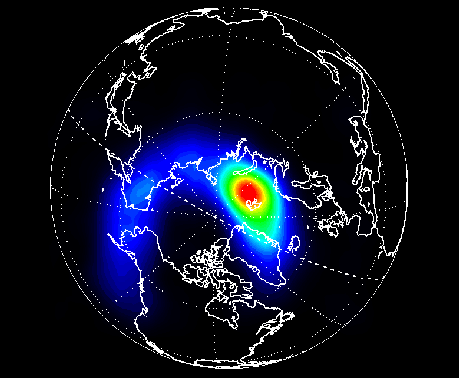
The Earth glows in many kinds of light, including the energetic X-ray band. Actually, the Earth itself does not glow - only aurora produced high in the Earth's atmosphere. Above is the first picture of the Earth in X-rays, taken in March with the orbiting Polar satellite. Bright X-ray emission is shown in red. Energetic ions from the Sun cause aurora and energize electrons in the Earth's magnetosphere. These electrons move along the Earth's magnetic field and eventually strike the Earth's ionosphere, causing the X-ray emission. These X-rays are not dangerous because they are absorbed by lower parts of the Earth's atmosphere.