The Sun
The Sun is a yellow dwarf star (G2V), about 4.6 billion years old, and the dominant gravitational force in the Solar System. It has a diameter of roughly 1.4 million kilometers and contains around 99.8% of the Solar System’s mass. Nuclear fusion in its core converts hydrogen into helium, producing energy that warms the planets. Above the core lie the radiative and convective zones, followed by the visible photosphere (~5,500 °C), the chromosphere, and the much hotter corona (~2 million °C).
Source: science.nasa.gov
APODs including "The Sun"
Red Sun Streaming
07/01/1997
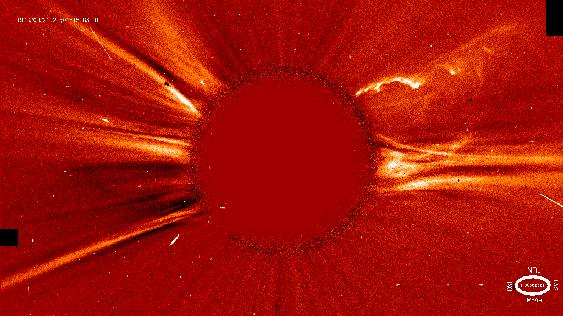
The Sun is leaking. In fact, it is gushing: particles stream away from the Sun at hundreds of kilometers per second. Some of these particles strike the Earth and cause aurora. Most particles, however, either surround the Sun as a huge solar corona or glide into interstellar space as the solar wind. Don't worry about the Sun totally evaporating - it loses too little mass to have any lasting effect. The above false-color picture was taken with the Large Angle and Spectrometric Coronograph on board the SOlar and Heliospheric Observatory (SOHO). This instruments blocks out the central solar disk so it can image the regions surrounding the Sun. The large streamers visible are typical. Where these charged ions get their enormous streaming energy is still a mystery!