The Sun
The Sun is a yellow dwarf star (G2V), about 4.6 billion years old, and the dominant gravitational force in the Solar System. It has a diameter of roughly 1.4 million kilometers and contains around 99.8% of the Solar System’s mass. Nuclear fusion in its core converts hydrogen into helium, producing energy that warms the planets. Above the core lie the radiative and convective zones, followed by the visible photosphere (~5,500 °C), the chromosphere, and the much hotter corona (~2 million °C).
Source: science.nasa.gov
APODs including "The Sun"
Mercury in Stereo: Craters Within Craters
12/01/1997
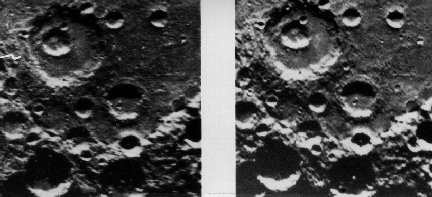
This Stereo image pair of craters on on Mercury was produced using data from NASA's robot explorer Mariner 10 which performed three close flybys of the Sun's closest companion, two in 1974 and one in 1975. However, the spacecraft was not equipped with a Stereo camera! Instead, the Stereo pair was created using two images of the same region each recorded from a slightly different angle. The image on the left was actually taken during the first flyby, the one on the right during the second. A crater within a crater is visible at the upper left, the outer one is about 70 miles in diameter. The embedded craters themselves are within the 230 mile wide Dostoevsky crater - a segment of Dostoevsky's rim runs through the lower half of the image. To get the 3D Stereo effect, your left eye should see only the left image and your right eye only the right one. (Try placing one edge of a piece of paper on the screen between the pictures and touching your nose to the other edge while viewing.)