The Sun
The Sun is a yellow dwarf star (G2V), about 4.6 billion years old, and the dominant gravitational force in the Solar System. It has a diameter of roughly 1.4 million kilometers and contains around 99.8% of the Solar System’s mass. Nuclear fusion in its core converts hydrogen into helium, producing energy that warms the planets. Above the core lie the radiative and convective zones, followed by the visible photosphere (~5,500 °C), the chromosphere, and the much hotter corona (~2 million °C).
Source: science.nasa.gov
APODs including "The Sun"
Comet Hale-Bopp Returns Credit and Copyright:
06/02/1997
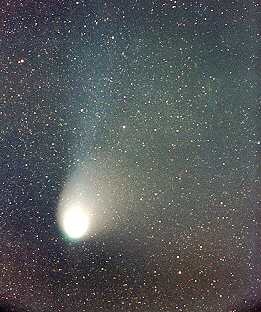
Comet Hale-Bopp has returned from behind the Sun. In December and early January, Comet Hale-Bopp was too near the Sun to be easily visible from Earth. Now the comet graces the morning sky and is visible from dark locations even without binoculars. The above photo was taken on January 31st and shows the two emerging tails of Comet Hale-Bopp. The blue wisp pointing up is the ion tale, while the white fuzz is the dust tail. On its trip to the inner Solar System, Comet Hale-Bopp is once again showing signs it could brighten in the next few months to become the most spectacular comet in modern times.