The Sun
The Sun is a yellow dwarf star (G2V), about 4.6 billion years old, and the dominant gravitational force in the Solar System. It has a diameter of roughly 1.4 million kilometers and contains around 99.8% of the Solar System’s mass. Nuclear fusion in its core converts hydrogen into helium, producing energy that warms the planets. Above the core lie the radiative and convective zones, followed by the visible photosphere (~5,500 °C), the chromosphere, and the much hotter corona (~2 million °C).
Source: science.nasa.gov
APODs including "The Sun"
A Wind From The Sun Credit:
17/02/1997
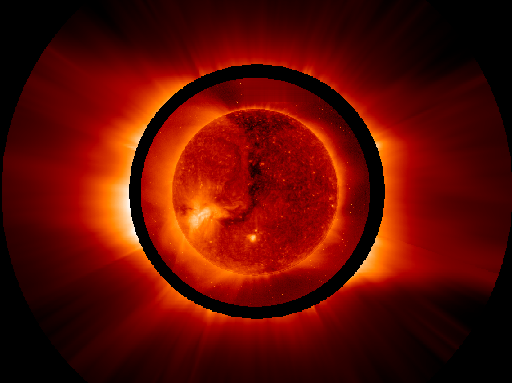
A wind from the Sun blows through our Solar System. The behaviour of comet tails as they flapped and waved in this interplanetary breeze gave astronomers the first hint of its existence. Streaming outward at 250-400 miles/second, electrons and ions boiling off the Sun's incredibly hot but tenuous corona account for the Solar Wind - now known to affect the Earth and other planets along with voyaging spacecraft. Rooted in the Solar Magnetic Field, the structure of the corona is visible in this composite image from the EIT and UVCS instruments onboard the SOHO spacecraft, extending a million miles above the Sun's surface. The dark areas, known as coronal holes, represent the regions where the highest speed Solar Wind originates.