The Sun
The Sun is a yellow dwarf star (G2V), about 4.6 billion years old, and the dominant gravitational force in the Solar System. It has a diameter of roughly 1.4 million kilometers and contains around 99.8% of the Solar System’s mass. Nuclear fusion in its core converts hydrogen into helium, producing energy that warms the planets. Above the core lie the radiative and convective zones, followed by the visible photosphere (~5,500 °C), the chromosphere, and the much hotter corona (~2 million °C).
Source: science.nasa.gov
APODs including "The Sun"
A Big Cliff on Jupiter's Callisto Credit:
18/02/1997
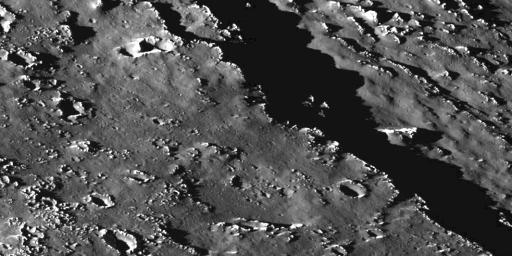
Callisto's surface is not without fault. In fact, an explorer crossing the surface of this large moon of Jupiter would need climbing equipment to pass this large, recently discovered fault. The above picture was released last week and was taken in November 1996 by the robot spacecraft Galileo currently orbiting Jupiter. As the Sun illuminates Callisto's surface from the left, the unusual cliff or scarp stands out by the shadow it casts to the right. This cliff and others were probably formed when a large object collided with Callisto early in its history. Of the many visible craters in the above photograph, the smallest visible is about a football field across, while the largest is more than a kilometer.