The Sun
The Sun is a yellow dwarf star (G2V), about 4.6 billion years old, and the dominant gravitational force in the Solar System. It has a diameter of roughly 1.4 million kilometers and contains around 99.8% of the Solar System’s mass. Nuclear fusion in its core converts hydrogen into helium, producing energy that warms the planets. Above the core lie the radiative and convective zones, followed by the visible photosphere (~5,500 °C), the chromosphere, and the much hotter corona (~2 million °C).
Source: science.nasa.gov
APODs including "The Sun"
Comet Hale-Bopp's Developing Tails Credit:
14/03/1997
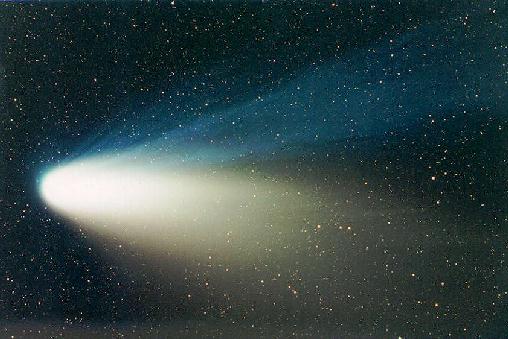
Comet Hale-Bopp is living up to its expectations. Besides the brightness of its coma, a comet is typically remembered by the length of its tails. As visible in the above picture taken last week, Comet Hale-Bopp's blue ion tail shows a dramatic extension, with current reports of about 20 degrees from dark locations. The comet's white dust tail has so far shown a more modest extent but appears to be growing significantly. Comet Hale-Bopp's closest approach to the Sun occurs in about two weeks, and although it will not get much closer to the Sun than does our Earth, Comet Hale-Bopp is likely to tell even more spectacular tails then.