The Sun
The Sun is a yellow dwarf star (G2V), about 4.6 billion years old, and the dominant gravitational force in the Solar System. It has a diameter of roughly 1.4 million kilometers and contains around 99.8% of the Solar System’s mass. Nuclear fusion in its core converts hydrogen into helium, producing energy that warms the planets. Above the core lie the radiative and convective zones, followed by the visible photosphere (~5,500 °C), the chromosphere, and the much hotter corona (~2 million °C).
Source: science.nasa.gov
APODs including "The Sun"
A Comet In The Sky Credit:
28/03/1997
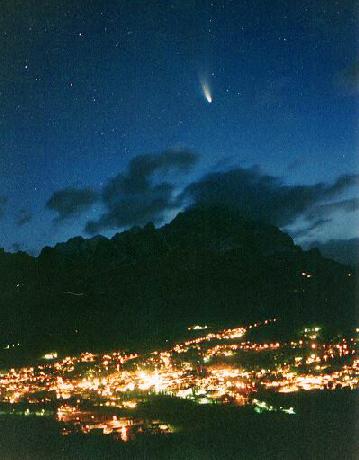
It has been suggested that Comet Hale-Bopp will become the most viewed comet in Human history. Presently, for denizens of the Earth's northern hemisphere, this bright comet is certainly a lovely and inspiring sight -- visible here crowning the sky above Cortina d'Ampezzo, Italy on March 20. Based on orbital calculations, this comet's last passage through the inner Solar System was approximately 4,200 years ago. Principally because of changes caused by the gravitational influence of Jupiter, Hale-Bopp should pass this way again in a mere 2,380 years. Comets come from the outer reaches of the Solar System where they reside, frozen and preserved. Astronomers analyzing their structure and composition as comets swing near the Sun seek a glimpse of the conditions during the Solar System's formative years.