The Sun
The Sun is a yellow dwarf star (G2V), about 4.6 billion years old, and the dominant gravitational force in the Solar System. It has a diameter of roughly 1.4 million kilometers and contains around 99.8% of the Solar System’s mass. Nuclear fusion in its core converts hydrogen into helium, producing energy that warms the planets. Above the core lie the radiative and convective zones, followed by the visible photosphere (~5,500 °C), the chromosphere, and the much hotter corona (~2 million °C).
Source: science.nasa.gov
APODs including "The Sun"
The Sun Puffs Credit:
11/04/1997
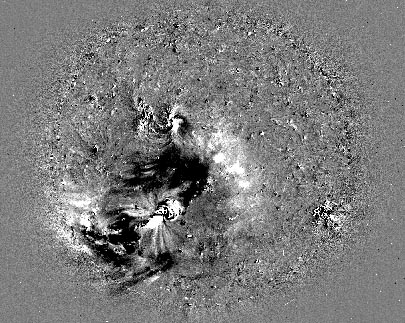
The Earth has once again endured a burst of particles from the Sun. The latest storm, which began Monday, was one of the best documented solar storms to date. At 10 am (EDT) ground monitors of the SOHO spacecraft, which continually monitors the Sun, noticed a weak spot in the solar corona was buckling again, this time letting loose a large, explosive Coronal Mass Ejection (CME). Almost simultaneously, NASA's WIND spacecraft began detecting bursts of radio waves from electrons involved in this magnetic storm. Supersonic waves rippled though the solar corona as a puff of high energy gas shot out into the Solar System. The above image shows two photographs of the Sun taken about 15 minutes apart and subtracted, highlighting the explosion. The CME gas will have little lasting effect on the Earth, but might make this a good weekend to see an aurora.