The Sun
The Sun is a yellow dwarf star (G2V), about 4.6 billion years old, and the dominant gravitational force in the Solar System. It has a diameter of roughly 1.4 million kilometers and contains around 99.8% of the Solar System’s mass. Nuclear fusion in its core converts hydrogen into helium, producing energy that warms the planets. Above the core lie the radiative and convective zones, followed by the visible photosphere (~5,500 °C), the chromosphere, and the much hotter corona (~2 million °C).
Source: science.nasa.gov
APODs including "The Sun"
Hale-Bopp's Hoods Credit:
14/04/1997
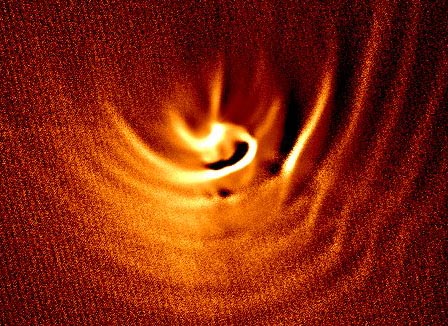
Comet Hale-Bopp is spinning. The nucleus of the comet is a dirty snowball about 25 miles in diameter that spins about once every 12 hours. As Comet Hale-Bopp spins, parts of the comet's surface shoot away in jets. Ejected material therefore makes rings, which appear in above photograph as "hoods" in the coma. Even though the central part of Comet Hale-Bopp's coma is quite condensed, the nucleus is not visible. Comet Hale-Bopp is now headed south, away from the Sun, and is getting dimmer. At its brightest last week, it was even brighter than Comet Hyakutake was last year, although with a less prominent tail. Comet Hale-Bopp will still be easily visible to northern observers for several weeks in the northwest sky after sunset.