The Sun
The Sun is a yellow dwarf star (G2V), about 4.6 billion years old, and the dominant gravitational force in the Solar System. It has a diameter of roughly 1.4 million kilometers and contains around 99.8% of the Solar System’s mass. Nuclear fusion in its core converts hydrogen into helium, producing energy that warms the planets. Above the core lie the radiative and convective zones, followed by the visible photosphere (~5,500 °C), the chromosphere, and the much hotter corona (~2 million °C).
Source: science.nasa.gov
APODs including "The Sun"
Hale-Bopp and Plateau de Bure Interferometer Credit and Copyright:
15/04/1997
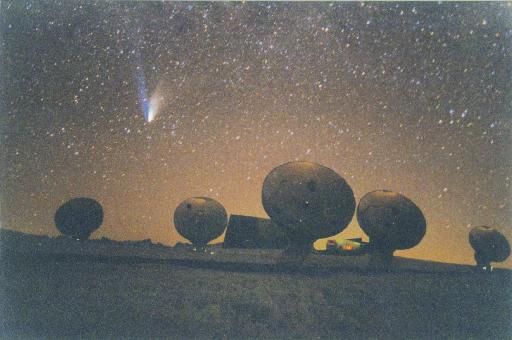
Comet Hale-Bopp is being observed by many different telescopes. Here the comet is pictured behind the array of radio telescopes which compose the Plateau de Bure Interferometer. These telescopes are being used to detect the presence of different molecules in the coma and tail of Comet Hale-Bopp. Molecules detected in the comet include carbon monoxide and sulfur dioxide. The abundance of different types of molecules in Comet Hale-Bopp's coma give clues to its composition and history, as well as clues to the composition and history of our Solar System. Comet Hale-Bopp has now rounded the Sun and is headed back out. It can still be seen by northern observers for several weeks in the northwest sky after sunset.