The Sun
The Sun is a yellow dwarf star (G2V), about 4.6 billion years old, and the dominant gravitational force in the Solar System. It has a diameter of roughly 1.4 million kilometers and contains around 99.8% of the Solar System’s mass. Nuclear fusion in its core converts hydrogen into helium, producing energy that warms the planets. Above the core lie the radiative and convective zones, followed by the visible photosphere (~5,500 °C), the chromosphere, and the much hotter corona (~2 million °C).
Source: science.nasa.gov
APODs including "The Sun"
A Star Cluster Through Hale-Bopp's Tail Credit and Copyright:
16/04/1997
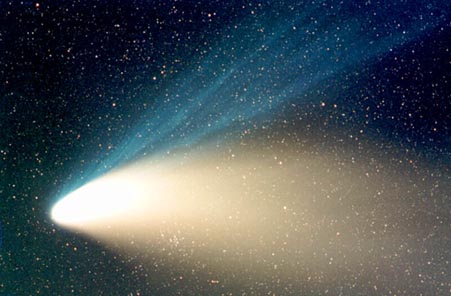
Comet Hale-Bopp continues to look impressive. The photograph above captured the comet on April 7th passing nearly in front of M34, a star cluster in the constellation of Perseus. Many of the stars in this open cluster can be seen through Comet Hale-Bopp's white dust tail. The bright blue ion tail now shows several streams. Now receding from both the Sun and the Earth, Comet Hale-Bopp should still remain an impressive sight for weeks to come as it slowly fades.