The Sun
The Sun is a yellow dwarf star (G2V), about 4.6 billion years old, and the dominant gravitational force in the Solar System. It has a diameter of roughly 1.4 million kilometers and contains around 99.8% of the Solar System’s mass. Nuclear fusion in its core converts hydrogen into helium, producing energy that warms the planets. Above the core lie the radiative and convective zones, followed by the visible photosphere (~5,500 °C), the chromosphere, and the much hotter corona (~2 million °C).
Source: science.nasa.gov
APODs including "The Sun"
Hale-Bopp's Fickle Ion Tail
14/05/1997
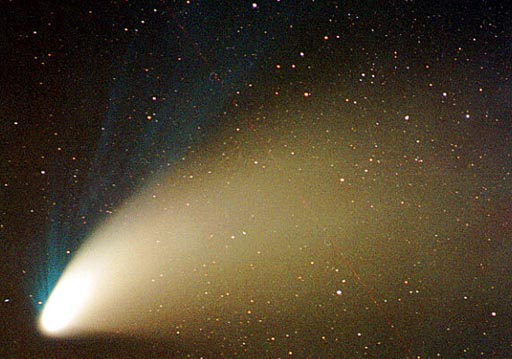
What's happening to Comet Hale-Bopp's blue ion tail? The comet's ion tail is fluctuating more rapidly as it passes a region of changing solar wind. As the comet passes from north to south, it crosses the plane of the Sun's equator, where the solar magnetic field changes direction. Ions from the solar wind, which cause Comet Hale-Bopp's ion tail, act unpredictably here. Therefore, Comet Hale-Bopp's ion tale may show unusual structure or even a disconnection - where the tail appears to break off and then reestablish itself later. The above picture, taken April 30th, indeed shows unusual structure in the blue ion tail.