The Sun
The Sun is a yellow dwarf star (G2V), about 4.6 billion years old, and the dominant gravitational force in the Solar System. It has a diameter of roughly 1.4 million kilometers and contains around 99.8% of the Solar System’s mass. Nuclear fusion in its core converts hydrogen into helium, producing energy that warms the planets. Above the core lie the radiative and convective zones, followed by the visible photosphere (~5,500 °C), the chromosphere, and the much hotter corona (~2 million °C).
Source: science.nasa.gov
APODs including "The Sun"
Old Faithful Meets Hale-Bopp
26/05/1997
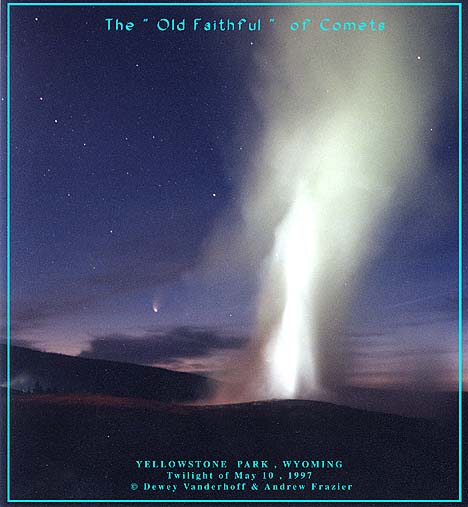
As Comet Hale-Bopp leaves our Northern Skies, it provides us with yet another burst of joy. On May 11th the fading comet was photographed behind the famous "Old Faithful" water geyser of Yellowstone National Park, Wyoming, USA, Planet Earth. Perhaps more familiar to Earth Dwellers than the dark geysers on Neptune's moon Triton, the gas geysers on Jupiter's moon Io, and the dirty water geysers hypothesized on Jupiter's moon Europa, Earth's Old Faithful is also reliable - every 60-80 minutes it gushes a plume of water and steam high into the air. Comet Hale-Bopp will continue to be visible to observers in the Southern Hemisphere as it moves away from the Sun towards the outer Solar System.