The Sun
The Sun is a yellow dwarf star (G2V), about 4.6 billion years old, and the dominant gravitational force in the Solar System. It has a diameter of roughly 1.4 million kilometers and contains around 99.8% of the Solar System’s mass. Nuclear fusion in its core converts hydrogen into helium, producing energy that warms the planets. Above the core lie the radiative and convective zones, followed by the visible photosphere (~5,500 °C), the chromosphere, and the much hotter corona (~2 million °C).
Source: science.nasa.gov
APODs including "The Sun"
Mars: Just The Fiction
28/05/1997
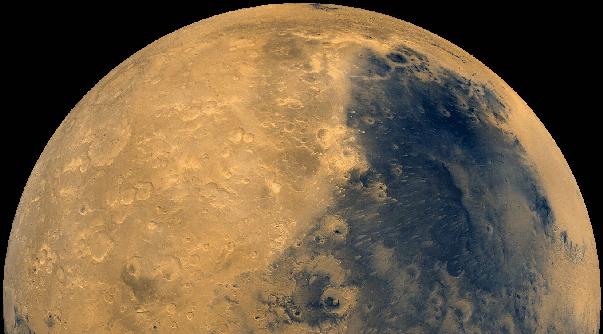
For centuries, astronomers have observed Mars, patiently compiling many facts and theories. Like a distant mirror of Earth dwellers' hopes and fears for the future, Mars, the fourth planet from the sun, has inspired profound works of fiction as well. Classics of the science fiction genre with visions of Earth's alluring planetary neighbor include H.G. Wells' terrifying "War of the Worlds", Edgar Rice Buroughs' John Carter adventure series (Thuvia, Maid of Mars, The Gods of Mars, A Princess of Mars, The Warlord of Mars), Robert Heinlein's youthful "Podkayne of Mars", and Ray Bradbury's reflective and philosophical "The Martian Chronicles". Through the years scientific theories about Mars have been disproven, but the sense of wonder and adventure embodied in these works of fiction remain with us. As two spacecraft from Earth now draw close to the red planet- in dreams, desires, and a quest for knowledge - we are once again bound for Mars.