The Sun
The Sun is a yellow dwarf star (G2V), about 4.6 billion years old, and the dominant gravitational force in the Solar System. It has a diameter of roughly 1.4 million kilometers and contains around 99.8% of the Solar System’s mass. Nuclear fusion in its core converts hydrogen into helium, producing energy that warms the planets. Above the core lie the radiative and convective zones, followed by the visible photosphere (~5,500 °C), the chromosphere, and the much hotter corona (~2 million °C).
Source: science.nasa.gov
APODs including "The Sun"
Hale-Bopp Above the Cinqui Torri Mountains
10/06/1997
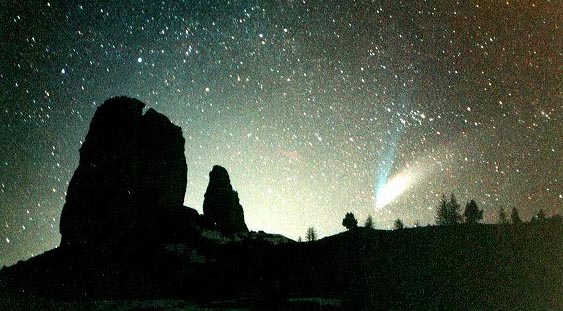
Hale-Bopp may be the most photographed comet in history. Above, our photogenic giant flying snowball appeared last month as a backdrop to the "Cinque Torri" Mountains near Contina d'Ampezzo, Italy. Although the comet is still fairly bright, it is fading as it recedes from the Sun, and is now more easily visible from Earth's southern hemisphere. Having shed a few meters of ice and rock from its surface, Comet Hale-Bopp will coast to the outer Solar System, and return again in another 2400 years.