The Sun
The Sun is a yellow dwarf star (G2V), about 4.6 billion years old, and the dominant gravitational force in the Solar System. It has a diameter of roughly 1.4 million kilometers and contains around 99.8% of the Solar System’s mass. Nuclear fusion in its core converts hydrogen into helium, producing energy that warms the planets. Above the core lie the radiative and convective zones, followed by the visible photosphere (~5,500 °C), the chromosphere, and the much hotter corona (~2 million °C).
Source: science.nasa.gov
APODs including "The Sun"
Asteroid 3753: Earth's Curious Companion
18/06/1997
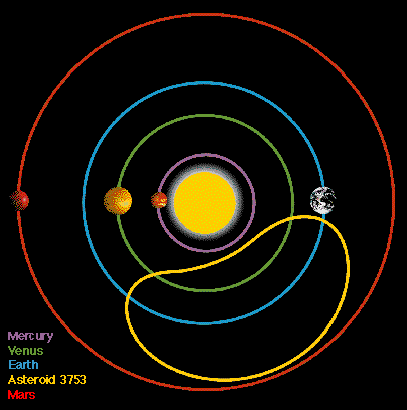
rth is not alone. It orbits the Sun with a small companion: Asteroid 3753. First discovered in 1986 and designated 1986 OT, this five kilometer rock was recently found to orbit the Sun while executing a strange dance with the Earth. A portion of the asteroid's complex orbit is shown above. As the Earth orbits once, Asteroid 3753 follows the yellow line - while also orbiting the Sun. Each time around, however, the yellow kidney-bean traced by Asteroid 3753 shifts slightly - eventually going from trailing the Earth to leading the Earth. Every 385 years the cycle repeats. Because the plane of 3753's orbit is tilted when compared to the Earth's orbit, the two will never collide. In autumn 1997, Asteroid 3753 will pass below the Earth's South Pole at about 100 times the distance to the Moon. It will, however, be very faint - about 15th magnitude - 10,000 times fainter than the dimmest star without a telescope. Suggestions are being taken for a good name for this asteroid.