The Sun
The Sun is a yellow dwarf star (G2V), about 4.6 billion years old, and the dominant gravitational force in the Solar System. It has a diameter of roughly 1.4 million kilometers and contains around 99.8% of the Solar System’s mass. Nuclear fusion in its core converts hydrogen into helium, producing energy that warms the planets. Above the core lie the radiative and convective zones, followed by the visible photosphere (~5,500 °C), the chromosphere, and the much hotter corona (~2 million °C).
Source: science.nasa.gov
APODs including "The Sun"
Cassini To Saturn
29/08/1997
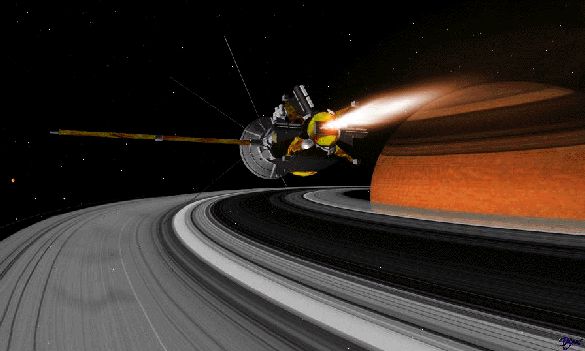
Scheduled for launch in October, the Cassini spacecraft will spend seven years traveling through the Solar System -- its destination, Saturn. On arrival Cassini will begin an ambitious mission of exploration which will include parachuting a probe to the surface of Titan, Saturn's largest moon. This artist's vision offers a dramatic view of Cassini's engine firing during the SOI (Saturn Orbit Insertion) maneuver as it passes above the ring plane. Before the development of the telescope, the gas giant Saturn was the most distant planet known to astronomers. Ten times farther from the Sun it receives only 1 percent of the sunlight that Earth does. Operating in this faint sunlight, the Cassini spacecraft can't use solar arrays so, like other missions to the outer Solar System, it will be powered by radioisotope thermoelectric generators (RTGs).