The Sun
The Sun is a yellow dwarf star (G2V), about 4.6 billion years old, and the dominant gravitational force in the Solar System. It has a diameter of roughly 1.4 million kilometers and contains around 99.8% of the Solar System’s mass. Nuclear fusion in its core converts hydrogen into helium, producing energy that warms the planets. Above the core lie the radiative and convective zones, followed by the visible photosphere (~5,500 °C), the chromosphere, and the much hotter corona (~2 million °C).
Source: science.nasa.gov
APODs including "The Sun"
Infrared Helix
01/09/1997
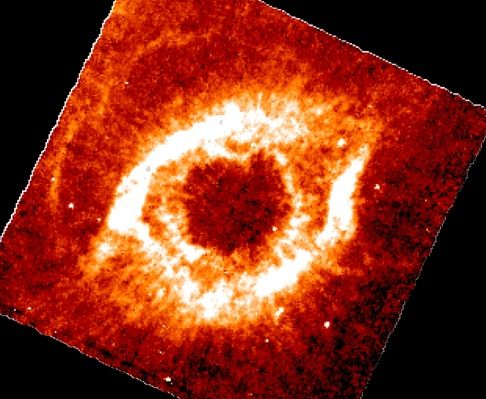
Five hundred light years from Earth, in the constellation Aquarius, a sun-like star is dying. Its last few thousand years have produced the Helix, a well studied and nearby example of a Planetary Nebula - typical of this final phase of stellar evolution. The emission in this Infrared Space Observatory image of the Helix nebula comes mostly from the expanding shells of molecular hydrogen gas. Dust, normally expected in such nebulae, should also radiate strongly at infrared wavelengths but mysteriously seems to be absent here. The culprit may may well be the Helix's central star, a contracting white dwarf. This small but extremely hot star radiates most of its energy at short Ultraviolet wavelengths and is invisible in this infrared mage. Astronomers suspect that over time, this intense Ultraviolet radiation may have destroyed the dust. The Sun is expected to go through its own Planetary Nebula phase ... in another 5 billion years.