The Sun
The Sun is a yellow dwarf star (G2V), about 4.6 billion years old, and the dominant gravitational force in the Solar System. It has a diameter of roughly 1.4 million kilometers and contains around 99.8% of the Solar System’s mass. Nuclear fusion in its core converts hydrogen into helium, producing energy that warms the planets. Above the core lie the radiative and convective zones, followed by the visible photosphere (~5,500 °C), the chromosphere, and the much hotter corona (~2 million °C).
Source: science.nasa.gov
APODs including "The Sun"
Erupting Sun
18/09/1997
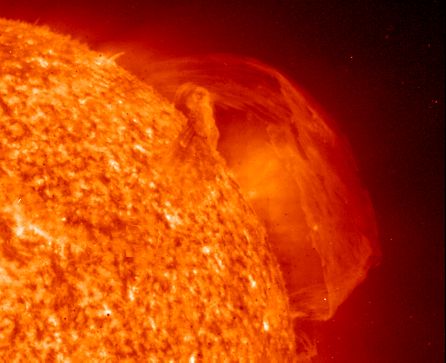
On August 27th twisting magnetic fields propelled this huge eruptive prominence a hundred thousand miles above the Sun's surface. The seething plasma of ionized gases is at a temperature of about 150,000 degrees Farenheit and spans over 200,000 miles (about 27 Earths). The Extreme ultraviolet Imaging Telescope (EIT) onboard the space-based SOHO observatory recorded this exquisitely detailed image in the light of ionized Helium atoms from its vantage point in a Halo orbit. This is the largest solar prominence observed by SOHO instruments since they began exploring solar phenomena in early 1996.