The Sun
The Sun is a yellow dwarf star (G2V), about 4.6 billion years old, and the dominant gravitational force in the Solar System. It has a diameter of roughly 1.4 million kilometers and contains around 99.8% of the Solar System’s mass. Nuclear fusion in its core converts hydrogen into helium, producing energy that warms the planets. Above the core lie the radiative and convective zones, followed by the visible photosphere (~5,500 °C), the chromosphere, and the much hotter corona (~2 million °C).
Source: science.nasa.gov
APODs including "The Sun"
Venus On The Horizon
14/10/1997
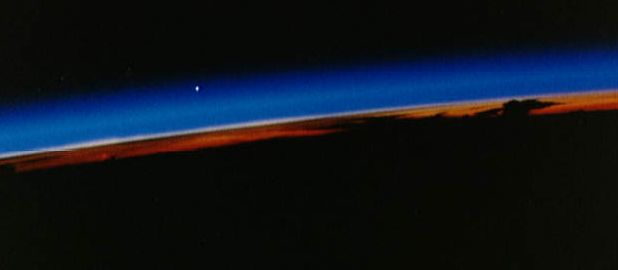
The month of October features a sky full of planets, including Venus as the brilliant evening star. Besides the sun and moon, Venus is the brightest object visible in Earth's sky. This month, Venus appears in early evening near the red planet Mars and Mars' red giant rival Antares above the southwestern horizon. Because it is closer to the sun than Earth, Venus never strays far from the sun in its apparent position and is seen during the year as either a bright morning or evening star. This beautiful sunset imaged from low earth orbit by the Atlantis space shuttle crew in May 1989 also reveals the planet Venus blazing above Earth's horizon. It is a fitting image for this mission and crew. It was recorded following the successful release of the robot Venus-explorer Magellan, the first planetary probe to be deployed from a space shuttle.