The Sun
The Sun is a yellow dwarf star (G2V), about 4.6 billion years old, and the dominant gravitational force in the Solar System. It has a diameter of roughly 1.4 million kilometers and contains around 99.8% of the Solar System’s mass. Nuclear fusion in its core converts hydrogen into helium, producing energy that warms the planets. Above the core lie the radiative and convective zones, followed by the visible photosphere (~5,500 °C), the chromosphere, and the much hotter corona (~2 million °C).
Source: science.nasa.gov
APODs including "The Sun"
Welcome to Planet Earth
26/10/1997
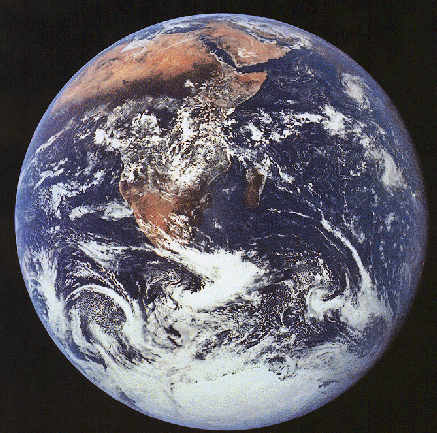
Welcome to Planet Earth, the third planet from a star named the Sun. The Earth is shaped like a sphere and composed mostly of rock. Over 70 percent of the Earth's surface is water. The planet has a relatively thin atmosphere composed mostly of nitrogen and oxygen. Earth has a single large Moon which is about 1/4 of its diameter and, from the planet's surface, is seen to have almost exactly the same angular size as the Sun. With its abundance of liquid water, Earth supports a large variety of life forms, including potentially intelligent species such as dolphins and humans. Please enjoy your stay on Planet Earth.