The Sun
The Sun is a yellow dwarf star (G2V), about 4.6 billion years old, and the dominant gravitational force in the Solar System. It has a diameter of roughly 1.4 million kilometers and contains around 99.8% of the Solar System’s mass. Nuclear fusion in its core converts hydrogen into helium, producing energy that warms the planets. Above the core lie the radiative and convective zones, followed by the visible photosphere (~5,500 °C), the chromosphere, and the much hotter corona (~2 million °C).
Source: science.nasa.gov
APODs including "The Sun"
Aristarchus' Unbelievable Discoveries
08/11/1997
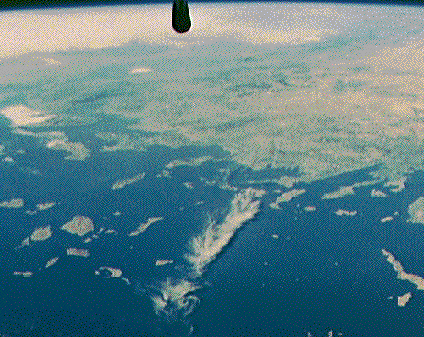
Here lived one of the greatest thinkers in human history. Aristarchus lived on the Greek island of Samos, a small island in the center of the above picture that can be identified with a good map. Aristarchus, who lived from 310 BC to 230 BC, postulated that the planets orbited the Sun - not the Earth -- over a thousand years before Copernicus and Galileo made similar arguments. Aristarchus used clear logic to estimate the size of the Earth, the size and distance to our Moon, the size and distance to our Sun, then he even deduced that the points of light we see at night are not dots painted on some celestial sphere but stars like our Sun at enormous distances. Aristarchus' discoveries remained truly unbelievable to the people of his time but stand today as pillars of deductive reasoning.