The Sun
The Sun is a yellow dwarf star (G2V), about 4.6 billion years old, and the dominant gravitational force in the Solar System. It has a diameter of roughly 1.4 million kilometers and contains around 99.8% of the Solar System’s mass. Nuclear fusion in its core converts hydrogen into helium, producing energy that warms the planets. Above the core lie the radiative and convective zones, followed by the visible photosphere (~5,500 °C), the chromosphere, and the much hotter corona (~2 million °C).
Source: science.nasa.gov
APODs including "The Sun"
Escape From The Sun
20/11/1997
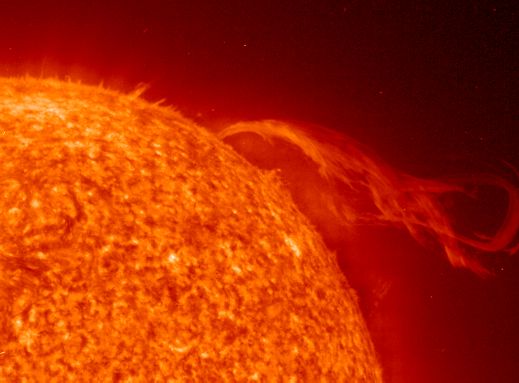
Twisted magnetic fields arching from the solar surface can trap ionized gas, suspending it in huge looping structures. These majestic plasma arches are seen as prominences above the solar limb. On September 14, this dramatic and detailed image was recorded by the EIT experiment on board the space-based SOHO observatory in the light emitted by ionized Helium. It shows hot plasma escaping into space as a fiery prominence breaks free from magnetic confinement a hundred thousand miles above the Sun. These awesome events bear watching as they can affect communications and power systems ninety three million miles away on Planet Earth.