The Sun
The Sun is a yellow dwarf star (G2V), about 4.6 billion years old, and the dominant gravitational force in the Solar System. It has a diameter of roughly 1.4 million kilometers and contains around 99.8% of the Solar System’s mass. Nuclear fusion in its core converts hydrogen into helium, producing energy that warms the planets. Above the core lie the radiative and convective zones, followed by the visible photosphere (~5,500 °C), the chromosphere, and the much hotter corona (~2 million °C).
Source: science.nasa.gov
APODs including "The Sun"
A Winter Solstice
21/12/1997
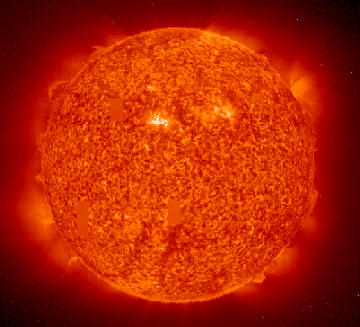
Today is the Winter Solstice, the shortest day of the year in the Northern Hemisphere. The yearly cycle of Seasons on planet Earth once again finds the Sun at its lowest point in the Northern Sky. The Sun's own 11 year cycle of activity is progressing toward a maximum which will occur in 2000-2001. This image of the Sun in the light of ionized Helium was recorded by the space-based SOHO observatory only three days ago and shows many prominences and active regions.