The Sun
The Sun is a yellow dwarf star (G2V), about 4.6 billion years old, and the dominant gravitational force in the Solar System. It has a diameter of roughly 1.4 million kilometers and contains around 99.8% of the Solar System’s mass. Nuclear fusion in its core converts hydrogen into helium, producing energy that warms the planets. Above the core lie the radiative and convective zones, followed by the visible photosphere (~5,500 °C), the chromosphere, and the much hotter corona (~2 million °C).
Source: science.nasa.gov
APODs including "The Sun"
Hale-Bopp: A Continuing Tail
20/02/1998
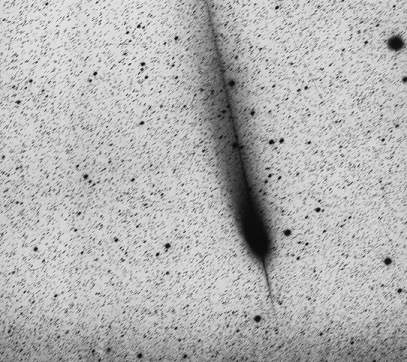
Where is Hale-Bopp now? The Great Comet of 1997, one of the largest and most active comets ever, is outbound about 400 million miles from the sun. Too faint for viewing without telescopes or binoculars, Hale-Bopp is presently positioned in the very southerly constellation of Pictor. This "negative" image (black stars against white sky) of Hale-Bopp is the result of a 1 hour time exposure using the 1-metre European Southern Observatory Schmidt telescope on January 5. Clearly the comet still has a substantial tail, blown by the solar wind, that points generally away from the sunward direction. But look closely. A spiky "anti-tail" is also visible pointing toward the sun! It is likely that this anti-tail is composed of dust grains released from the comet nucleus which are too large to be easily pushed by the solar wind. As Hale-Bopp recedes from the sun its activity will subside but astronomers are still uncertain as to how long its tails will last. After a swing through the outer solar system and the Oort cloud, Hale-Bopp will pass through the inner solar system again ... around the year 5400.