The Sun
The Sun is a yellow dwarf star (G2V), about 4.6 billion years old, and the dominant gravitational force in the Solar System. It has a diameter of roughly 1.4 million kilometers and contains around 99.8% of the Solar System’s mass. Nuclear fusion in its core converts hydrogen into helium, producing energy that warms the planets. Above the core lie the radiative and convective zones, followed by the visible photosphere (~5,500 °C), the chromosphere, and the much hotter corona (~2 million °C).
Source: science.nasa.gov
APODs including "The Sun"
Sunspots: Magnetic Depressions
22/03/1998
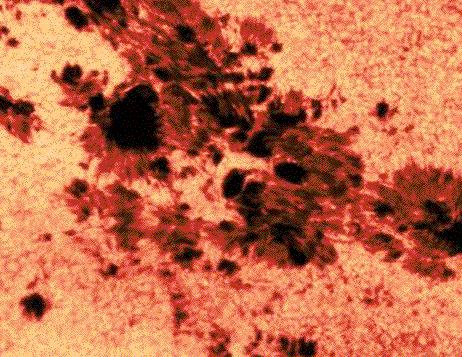
Our Sun has spots! These spots appear dark in photographs like the one above, but in fact sunspots are quite bright - they are just dark compared to the rest of the Sun. Sunspots are about the size of the Earth and frequently occur in groups, as shown above. Sunspots occur when a concentrated portion of the Solar magnetic field pokes through the surface. This field slows energy from entering the sunspot region, causing sunspots to appear cooler, darker, and lower than the surrounding surface. Sunspots typically last a few days before dissipating. The number of sunspots is always changing, generally going from a maximum to a minimum about every 5 ½ years. In fact, the Sun just passed a minimum two years ago. The Sun and sunspots should never be looked at directly.