The Sun
The Sun is a yellow dwarf star (G2V), about 4.6 billion years old, and the dominant gravitational force in the Solar System. It has a diameter of roughly 1.4 million kilometers and contains around 99.8% of the Solar System’s mass. Nuclear fusion in its core converts hydrogen into helium, producing energy that warms the planets. Above the core lie the radiative and convective zones, followed by the visible photosphere (~5,500 °C), the chromosphere, and the much hotter corona (~2 million °C).
Source: science.nasa.gov
APODs including "The Sun"
Astronaut Kicks Lunar Field Goal
01/04/1998
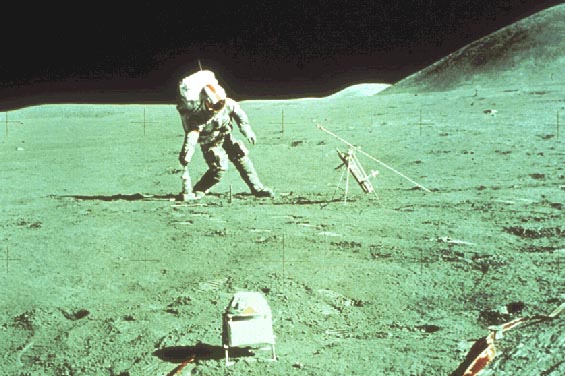
Score three points for NASA. With time running out late in Apollo 15's mission to the Moon in 1971, Astronaut David Scott prepared to "split the uprights" and bring about yet another dramatic end-of-the-mission win for NASA. Scott used a special "lunar football" designed for the rugged games held on the Moon. R1D1, a predecessor to R2D2, cheers from the sideline. Happy April Fools Day from the folks at APOD. In reality, Astronaut Scott adjusts one of Apollo 15's lunar experiments. The foreground device actually measured high-energy particles that escape from the Sun.