The Sun
The Sun is a yellow dwarf star (G2V), about 4.6 billion years old, and the dominant gravitational force in the Solar System. It has a diameter of roughly 1.4 million kilometers and contains around 99.8% of the Solar System’s mass. Nuclear fusion in its core converts hydrogen into helium, producing energy that warms the planets. Above the core lie the radiative and convective zones, followed by the visible photosphere (~5,500 °C), the chromosphere, and the much hotter corona (~2 million °C).
Source: science.nasa.gov
APODs including "The Sun"
Hyakutake: Comet Atmosphere
10/04/1998
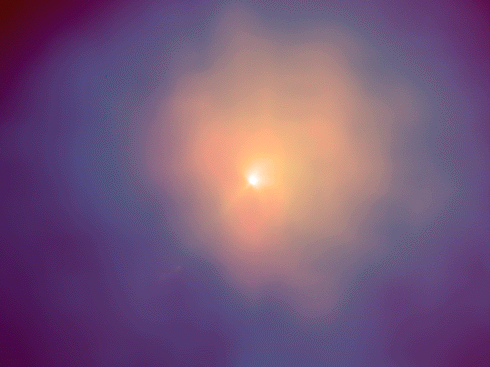
The atmosphere of a comet comes and goes. Approaching the sun, it swells as material from the icy cometary nucleus is warmed and evaporated by increasing sunlight. Immense but tenuous and fleeting, the inner atmosphere or inner "coma" of comet Hyakutake is seen in this false color picture. Oriented with the sunward direction toward the upper right, the picture is a composite of Hubble Space Telescope images recorded on April 3 and 4, 1996. It is about 14,000 km across (comparable to Earth's diameter) and is a combination of images showing dust reflected light (red) and ultraviolet light scattered from Hydrogen atoms (blue). Hyakutake's Hydrogen atoms were produced by the breakup of water (H20) molecules evaporating from its nucleus. The Hydrogen data, combined with other observations, indicate that this comet's nucleus, itself only a few km across, was producing about 7 to 8 tons of water per second.