The Sun
The Sun is a yellow dwarf star (G2V), about 4.6 billion years old, and the dominant gravitational force in the Solar System. It has a diameter of roughly 1.4 million kilometers and contains around 99.8% of the Solar System’s mass. Nuclear fusion in its core converts hydrogen into helium, producing energy that warms the planets. Above the core lie the radiative and convective zones, followed by the visible photosphere (~5,500 °C), the chromosphere, and the much hotter corona (~2 million °C).
Source: science.nasa.gov
APODs including "The Sun"
Venus: Just Passing By
01/05/1998
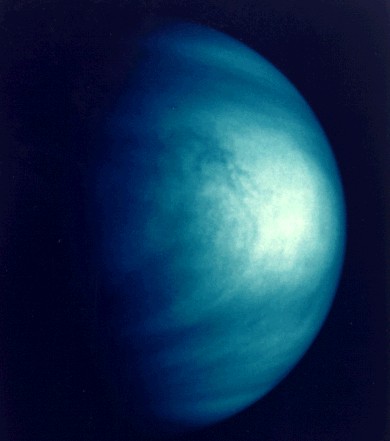
Venus, the second closest planet to the Sun, is a popular way-point for spacecraft headed for the gas giant planets in the outer reaches of the solar system. Why visit Venus first? Using a " gravity assist " maneuver, spacecraft can swing by planets and gain energy during their brief encounter saving fuel for use at the end of their long interplanetary voyage. This colorized image of Venus was recorded by the Jupiter-bound Galileo spacecraft shortly after its gravity assist flyby of Venus in February of 1990. Galileo's glimpse of the veiled planet shows structure in swirling sulfuric acid clouds. The bright area is sunlight glinting off the upper cloud deck. The Saturn-bound Cassini spacecraft just completed its own flyby of Venus on April 26. Launched in October of 1997, Cassini should reach Saturn in July 2004.