The Sun
The Sun is a yellow dwarf star (G2V), about 4.6 billion years old, and the dominant gravitational force in the Solar System. It has a diameter of roughly 1.4 million kilometers and contains around 99.8% of the Solar System’s mass. Nuclear fusion in its core converts hydrogen into helium, producing energy that warms the planets. Above the core lie the radiative and convective zones, followed by the visible photosphere (~5,500 °C), the chromosphere, and the much hotter corona (~2 million °C).
Source: science.nasa.gov
APODs including "The Sun"
TRACE and the Active Sun
15/05/1998
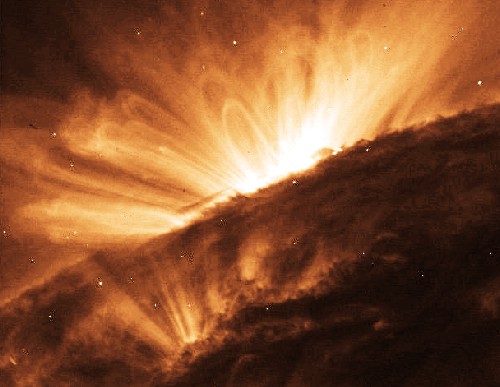
This dramatic high resolution picture looking across the edge of the Sun was taken April 24th by a telescope on board the newly launched Transition Region and Coronal Explorer (TRACE) satellite. It shows graceful arcs of intensely hot gas suspended in powerful looping magnetic fields which soar above a solar active region. The colorized image was made in the extreme ultraviolet light radiated by highly ionized Iron atoms. With a temperature of a mere 6,000 degrees Celsius, the sun's surface is relatively cool and dark at these wavelengths, but the million degree hot plasma loops glow strongly! Such TRACE images follow the plasma and magnetic structures arising from the surface of the sun as they merge with the tenuous, hot solar Corona or outer atmosphere. By operating the TRACE instruments during the Sun's increasingly active phase, scientists hope to explore the connections between complex solar magnetic fields and potentially hazardous solar eruptions.