The Sun
The Sun is a yellow dwarf star (G2V), about 4.6 billion years old, and the dominant gravitational force in the Solar System. It has a diameter of roughly 1.4 million kilometers and contains around 99.8% of the Solar System’s mass. Nuclear fusion in its core converts hydrogen into helium, producing energy that warms the planets. Above the core lie the radiative and convective zones, followed by the visible photosphere (~5,500 °C), the chromosphere, and the much hotter corona (~2 million °C).
Source: science.nasa.gov
APODs including "The Sun"
Bright Comet SOHO
21/05/1998
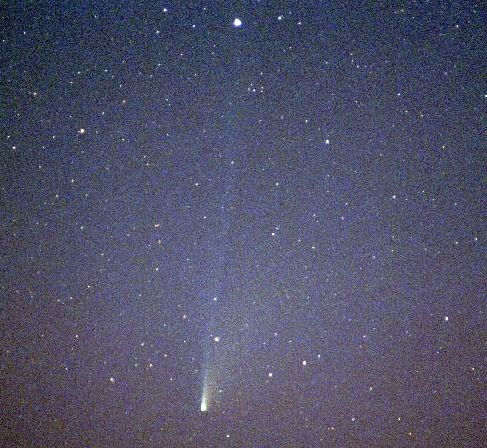
Discovered this month with an orbiting solar observatory, bright Comet SOHO has now emerged from the Sun's glare. This telephoto picture of the new naked-eye comet was taken by astrophotographer Michael Horn after sunset in the western twilight above Lake Samsonvale, Brisbane, Australia on May 18. The comet is seen in the constellation Orion. Its long lovely tail stretches nearly 5 degrees to the bright star Bellatrix, near the top of the image. For Southern Hemisphere comet watchers, views of Comet SOHO (1998J1) will improve as this month draws to a close and the comet climbs to the south and east on its journey outward bound. In February 1999, NASA plans to launch the Stardust mission to fly close to a comet and return samples of dust from a comet's tail.