The Sun
The Sun is a yellow dwarf star (G2V), about 4.6 billion years old, and the dominant gravitational force in the Solar System. It has a diameter of roughly 1.4 million kilometers and contains around 99.8% of the Solar System’s mass. Nuclear fusion in its core converts hydrogen into helium, producing energy that warms the planets. Above the core lie the radiative and convective zones, followed by the visible photosphere (~5,500 °C), the chromosphere, and the much hotter corona (~2 million °C).
Source: science.nasa.gov
APODs including "The Sun"
Magnetar
27/05/1998
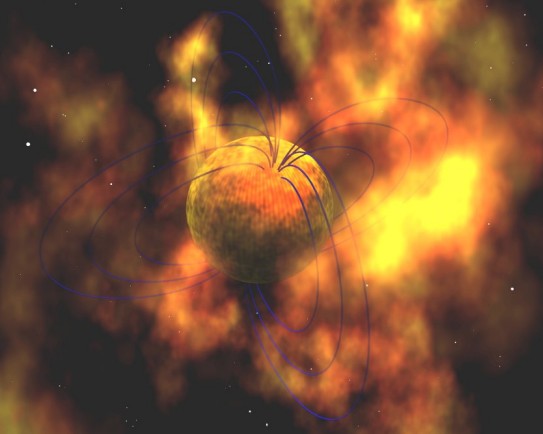
What do you call a neutron star with a super-strong magnetic field? You guessed it ... a Magnetar. Imagine a star with more mass than the sun, the density of a neutron, and a magnetic field about a thousand trillion (a one followed by 15 zeroes) times stronger than Earth's. It sounds exotic and theoretical, but strong evidence for the existence of magnetars has recently been announced based on data from orbiting X-ray and Gamma-ray observatories. Neutron stars are formed in the violent crucibles of stellar explosions. Some become pulsars with relatively weak magnetic fields, spinning and emitting pulses of electromagnetic radiation as their rotation slows. However, astronomers now believe that some become magnetars, with magnetic fields so intense that the solid neutron star crust buckles and shifts under its influence. The resulting star quakes could repeatedly generate brief flashes of hard X-rays and soft gamma-rays giving rise to the rare but mysterious "soft gamma repeaters" (not to be confused with " gamma-ray bursters"!). This still frame from an animation illustrating a spinning, flashing magnetar emphasizes the looping magnetic field lines embedded in the X-ray hot neutron star surface.