The Sun
The Sun is a yellow dwarf star (G2V), about 4.6 billion years old, and the dominant gravitational force in the Solar System. It has a diameter of roughly 1.4 million kilometers and contains around 99.8% of the Solar System’s mass. Nuclear fusion in its core converts hydrogen into helium, producing energy that warms the planets. Above the core lie the radiative and convective zones, followed by the visible photosphere (~5,500 °C), the chromosphere, and the much hotter corona (~2 million °C).
Source: science.nasa.gov
APODs including "The Sun"
Hyakutake: Stars Through A Comet's Tail
17/07/1998
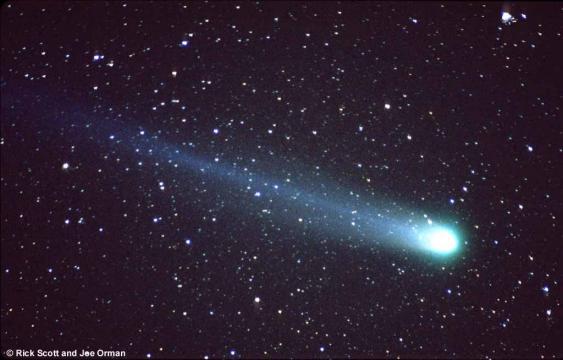
Comets are cosmic icebergs. They follow very elongated orbits which carry them from the frozen, remote outer reaches of the Solar System to close encounters with the Sun. Heated by sunlight, they slough off layers of material as gas and dust, forming their characteristic awe-inspiring comas (heads) and tails. In the spring of 1996, Comet Hyakutake inspired Arizona photographers Rick Scott and Joe Orman to take this picture showing faint stars near the constellation Ursa Minor (the Little Dipper) shining through the comet's long, graceful tail. Blown by the solar wind, comet tails generally point away from the Sun.