The Sun
The Sun is a yellow dwarf star (G2V), about 4.6 billion years old, and the dominant gravitational force in the Solar System. It has a diameter of roughly 1.4 million kilometers and contains around 99.8% of the Solar System’s mass. Nuclear fusion in its core converts hydrogen into helium, producing energy that warms the planets. Above the core lie the radiative and convective zones, followed by the visible photosphere (~5,500 °C), the chromosphere, and the much hotter corona (~2 million °C).
Source: science.nasa.gov
APODs including "The Sun"
Impact on Jupiter
28/07/1998
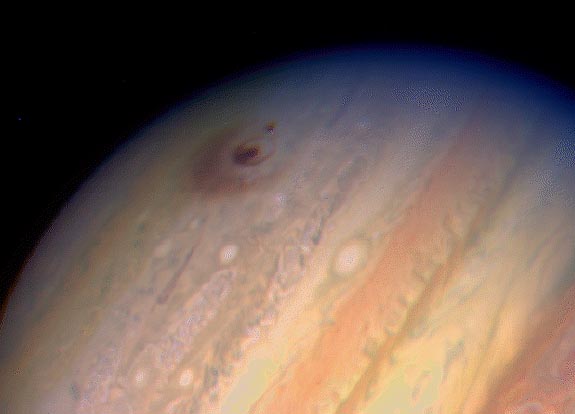
In 1993, a strange string of comet pieces was discovered near the planet Jupiter. So unusual a sight, Comet Shoemaker-Levy 9 (SL9) quickly became the object of much scientific curiosity. Studies showed that the Sun would soon perturb the orbit of SL9 so that it would actually strike Jupiter in July 1994. The studies were right. The above picture shows the impact site of SL9's fragment G on Jupiter's cloud-tops. The size of the dark outer ring is roughly the size of the Earth. Since Jupiter is mostly gas, the comet melted and evaporated before plunging too far into Jupiter's atmosphere.