The Sun
The Sun is a yellow dwarf star (G2V), about 4.6 billion years old, and the dominant gravitational force in the Solar System. It has a diameter of roughly 1.4 million kilometers and contains around 99.8% of the Solar System’s mass. Nuclear fusion in its core converts hydrogen into helium, producing energy that warms the planets. Above the core lie the radiative and convective zones, followed by the visible photosphere (~5,500 °C), the chromosphere, and the much hotter corona (~2 million °C).
Source: science.nasa.gov
APODs including "The Sun"
Volcanos on Mars: Elysium Region
30/07/1998
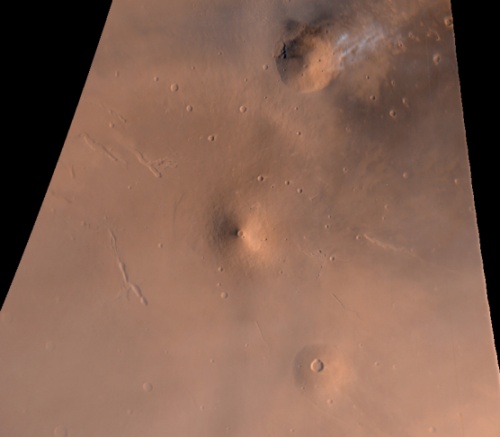
This "synthetic color" image swath of the Elysium Volcanic Region of Mars was recorded by Mars Global Surveyor's wide angle camera on July 2. North is up and the sun illuminates the scene from the lower right. Bright clouds hover near the northern most dome-shaped volcano Hecates Tholus. The shield volcano Elysium Mons lies about 250 miles south near the image center, and farther south lies another dome-shaped volcano, Albor Tholus, with a broad summit basin or caldera. Even though Mars is just half the size of planet Earth, it is known for its volcanos - the largest of which dwarf their terrestrial counterparts.